Child learning

Language in the home

Language is a fundamental part of our everyday lives and forms a core essential element in the primary school curriculum. Language permeates all aspects of school life, from the school yard to the classroom. It is central not only in the teaching of English and Irish, but in all subjects of the curriculum. The Irish and English curricula have three strands. These are oral language, reading and writing. The foundations for language development are laid first and foremost in the home. Exposure to rich and varied language in oral form or the written word at home will have far reaching benefits to the child’s progress in school. There are many ways you can support your child’s language development at home. Communication is a core part of language and it is important that your child has opportunities to converse, participate in discussions and develop their vocabulary at home. The PLC or Primary Language Curriculum was launched in 2016 and replaced the existing curricula for Irish and English. Diverse language experiences are central in our lessons in Irish and English. See the link below which will give you some very useful tips on how to support literacy development at home.

Child learning

Google Classroom

Google Classroom is the approved online learning platform in Drimoleague National School. Through using Google Classroom, pupils can find and complete tasks assigned to them by their teachers and teachers can create a range of learning activities that are engaging and varied, all supporting the work of the curriculum. Children can complete their tasks using one of the many tools on Google and these are stored automatically in the child’s Google Drive folder.

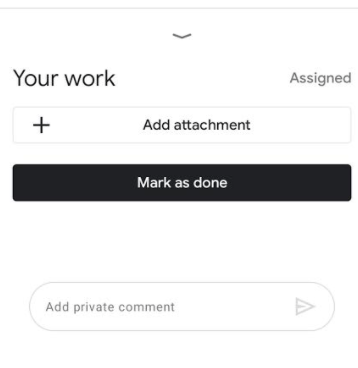
The easiest way to upload a photo or video of your child’s work is using the Google Classroom app on an iPad or your smartphone. Follow these steps:

  1. Download the Google Classroom app from Play Store
  2. Sign into Google Classroom using your child’s login details.
  3. Go to the assignment that has been given to your child by their teacher.

4. Go to the ‘Your Work’ box and click on ‘Add attachment

5. Now you can attach a photo of your child’s work from their book or copybook, their artwork, etc.

Please ensure the following when you are taking photos of your child’s work:

  • Make sure photos are clear, in focus and have no shadows
  • One page per photo: Take a photo of one page at a time so that the text is clear enough for correcting.
  • Please make sure the photo is turned the correct way to make it more manageable to correct, and easier for children to see any comments that teachers post on their work.

6. If your child’s teacher has asked for a recording of your child reading, you can upload in the same way but using the ‘Record Video’ tab. Please ensure that your child is not visible in the video – the camera should be focussed on the book that they are reading from.

7. Don’t forget to click on ‘Mark as Done’ once the assignment has been completed. The photo will now be send to your child’s teacher via Google Classroom.


Child learning

Independent Reading

Independent reading refers to reading for pleasure in children’s free time using books of their own choosing. It does not involve reading homework that may be set for children or reading from the school textbooks. Reading is a life-long skill and various studies show that proficient readers transfer these skills into other areas. It also helps children cope more easily with the transition into secondary school where text is significantly more challenging. Through reading a variety of books, children will not only improve their literacy skills but will also learn new information, develop empathy, improve memory and engage in an activity proven to have a positive impact on mental health. In an age where children have constant access to technology and lead busy lives both inside and outside of school, it is important that children are given opportunities to ‘switch off’ and experience the joy and pleasure in reading a good book.

There are many ways in which you, as parents, can support the school and your child in becoming an independent reader:

  1. Read with your child and discuss their book with them: Children are never too old to have an adult read to them, or to have someone listening to them while they read. It is important to discuss their book with them as this will help them better understand the storyline and connect with the text. Examples of discussion points are plot, character, favourite/least favourite parts, parts of the book you would like to change, predicting what you think will happen next, etc.
  2. Help your child when choosing books: It is important that children choose a book that is at their own reading level, not too difficult or easy, on a topic that they enjoy. In school we have taught children how to choose a ‘Just Right’ book using the five finger rule.
  3. Have a ‘Reading Corner’ at home: Having a quiet and comfortable corner at home, away from distractions can entice children to read in their spare time.
  4. Model good reading for your child: If children see adults reading books in the home, they are more likely to follow suit!
  5. ‘Reading Time’ at home: Set aside 10 minutes in the day when your child can read his/her book. This does not have to be every day but the time and place should be consistent in order to establish a routine. Ideally, an adult should also sit and read their own book during this time too.
  6. Read with your child and discuss their book with them: Children are never too old to have an adult read to them, or to have someone listening to them while they read. It is important to discuss their book with them as this will help them better understand the storyline and connect with the text. Examples of discussion points are plot, character, favourite/least favourite parts, parts of the book you would like to change, predicting what you think will happen next, etc.

Child learning

Homework tips

Step by Step

  • Agree on a set time for homework  – allow some element of choice within the agreed time-frame.
  • Be consistent and stick to the agreed routine.
  • Create a good learning space, by providing good seating and lighting for your child.
  • Revise for tests over a number of nights, rather than cramming the night before a test.
  • Encourage your child to complete the homework independently and check the work afterwards.
  • If your child is struggling with some of the homework, come back to it later and avoid showing showing impatience or frustration regarding the homework.
  • Allow children to make mistakes. ‘Mistakes are proof that they are trying.’
  • Praise your child’s effort and persistence at finishing their tasks.
  • Encourage independence, but it is important that you check your child’s homework each night and sign their homework journal.
  • If your child looks for help, it is better to guide them through finding the solution as opposed to just giving the answer. Ask them questions that will guide them.

Why is homework important?

  • Homework allows your child to consolidate, revise and reinforce what they have learned in school.
  • It allows you to see how your child is progressing in school and it strengthens home-school communication.
  • Your child will learn to become an independent learner.
  • Often, children will have more time (and peace and quiet!) at home to undertake research or conduct project work as part of their homework.

Remember: If your child has ongoing difficulties with their homework, make an appointment to discuss this with the class teacher.